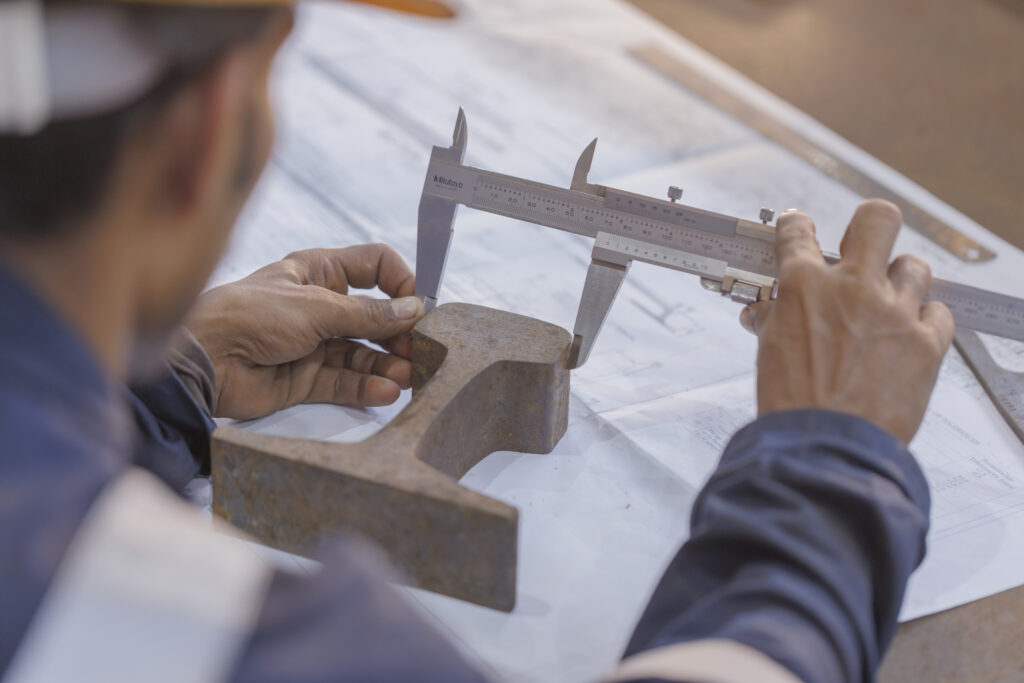
From requirement to production-ready solution.
AT A GLANCE
The expertise behind every development
Design
Product Development
AutoCAD
2D Drafting
3D
Component & Assembly Modelling
Simulation
Casting Flow & Solidification
Material
Chemistry Development
Process
Casting Methodology
PATTERN
Design & Development
Tooling
Custom Cutters & Fixtures
Prototyping
Testing & Refinement
Global
Specialist Design Partnerships
DESIGN BASIS
Design begins with what the product must do
Function and Loading
Static, dynamic, impact and fatigue loads are considered according to the component and its operating environment.
Strength and Weight
Geometry, wall sections and material properties are balanced to achieve the required strength without adding unnecessary weight.
Wear and Service Conditions
Material and process decisions consider abrasion, impact, temperature, corrosion and other application-specific conditions.
Dimensions and Interfaces
Critical dimensions, datums, clearances and mating surfaces are defined to support accurate fitment within the final assembly.
Production Requirements
Expected volumes, delivery timelines, repeatability and production economics are incorporated into the development process.
DIGITAL ENGINEERING
Identify risk before production begins
2D Engineering
AutoCAD-based drawings define component geometry, dimensions, tolerances, material requirements and production information.
- Detailed engineering drawings
- Production and inspection dimensions
- Drawing development and revision control
- Customer drawing conversion and detailing
3D Modelling
Component and assembly models help evaluate geometry, fitment and critical interfaces before tooling is developed.
- 3D casting and pouring simulation
- Process validation
- Risk identification
- Manufacturing optimisation
- Design refinement before production
Casting Simulation
Digital filling and solidification studies support the development of a sound and efficient casting route.
- Gating and risering design
- Moulding and pouring strategy
- Process-parameter development
- Continuous process improvement
MATERIAL ENGINEERING
Developing the material and the method together
Chemistry Development
Chemical composition can be developed within applicable specifications to achieve the required mechanical and service properties. Alloying elements such as nickel and molybdenum may be introduced where the application requires improved strength, toughness, hardenability or wear resistance.
Gating and Risering
Feeding paths, risers and gating systems are developed around the component geometry to promote controlled mould filling and directional solidification.
Geometry and Wall Sections
Wall thicknesses, transitions, fillets and machining allowances are reviewed to balance strength, weight, casting soundness and material utilisation.
Process Optimisation
Simulation, trial results and production feedback are used to reduce defects, improve casting yield and establish more consistent process parameters.
PRODUCTION ENGINEERING
Control the details that shape the product
Pattern Development
Wooden and aluminium pattern facilities support the development of tooling around the component geometry, moulding process and required dimensional allowances. Direct coordination between design and pattern development enables faster revisions and greater control over critical sections.
- Wooden and aluminium pattern development
- Shrinkage and machining allowances
- Wall-thickness and dimensional control
- Faster design revisions
- Support for new-product development
Custom Tooling
Component-specific cutters, fixtures and workholding systems are developed to improve machining access, stability and cycle time.
- Custom cutter and fixture design
- Tooling for specialised geometries
- Fewer machining setups
- Reduced machining cycle time
- Greater dimensional consistency
Machining Development
Datums, machining sequences and inspection stages are planned around the component's critical dimensions and mating interfaces. Multi-axis and double-head CNC systems support complex machining in fewer setups, with drawing-specific tolerances and surface roughness down to Ra 3 µm.
PROTOTYPING AND VALIDATION
Develop. Test. Improve. Repeat.
Initial components are produced to verify the design, material behaviour and practical production route.
Chemical, physical, metallurgical and dimensional checks are carried out at relevant stages to identify variations early.
Prototype results are reviewed against the customer's drawings, operating requirements and acceptance criteria.
Findings are used to adjust geometry, chemistry, casting methodology, patterns, tooling, heat treatment or machining parameters.
Once the required outcome is achieved, the drawings, chemistry, methoding, treatment cycle, machining programme and inspection plan are standardised for repeat production.
PROVEN APPLICATION
From operating requirements to complete solutions
SPECIALIST COLLABORATION
Global knowledge. Practical application.
Domain Expertise
Relevant specialists can be brought into a project according to its technical and industry-specific requirements.
Design Validation
Collaborative reviews provide additional technical scrutiny for complex products, systems and operating conditions.
Global Requirements
Designs can be aligned with applicable EN, ISO, customer and regional standards without losing sight of local operating conditions or production economics.
Knowledge Transfer
Continued interaction with technology partners strengthens internal practices and supports the adoption of evolving methods and systems.
INTERFACE CONTRO
Every component aligned to the final solution
Technical Alignment
Drawings, dimensions and fitment requirements are communicated across all connected components.
Supplier Qualification
Suppliers and their processes are assessed against the technical, quality and traceability needs of the project.
Technology Updates
Technical partners are kept aligned with approved changes in designs, components and production systems.
Change Control
Material, process and design changes are reviewed before being introduced into regular supply.